
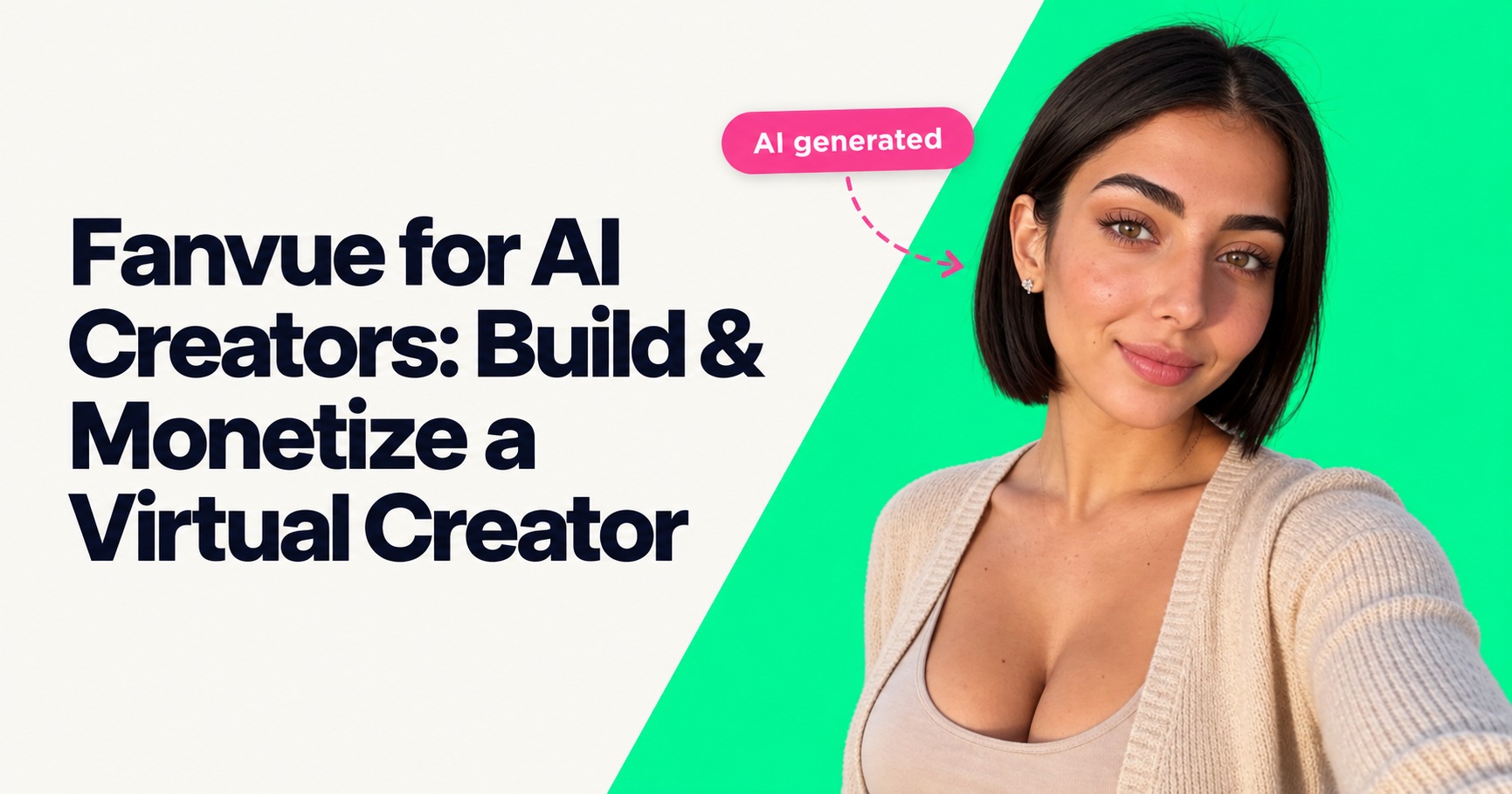
Building an AI creator and monetizing one are two different problems. Generative AI can create a convincing virtual personality, but a sustainable creator business still needs an audience, a paid offer and a platform capable of turning attention into recurring revenue.
Fanvue is particularly relevant because it explicitly recognises AI creators as a verified category. The platform allows AI-generated media under its rules, labels AI creator profiles for transparency and gives creators access to subscriptions, pay-per-view content, messaging, tips and native discovery. That makes it possible to build the virtual character and the monetization system as parts of the same business.
Quick Answer
Fanvue supports verified AI creators and allows AI-generated media when it follows the platform’s disclosure, safety, consent and content rules. An AI creator can monetize through recurring subscriptions, pay-per-view content, paid messages, tips and other fan interactions. The strongest strategy is to build a consistent virtual character first, attract an audience through public content, then use Fanvue as the monetization layer where followers become subscribers and paying fans.
1. Build the Creator Before Building the Paywall
The first step is not setting a subscription price. It is creating a virtual personality that people can recognize and understand.
Define the character’s appearance, niche, personality and content style before producing large amounts of media. A travel AI creator should have a different visual world and audience promise from a fitness personality or fashion influencer. That positioning determines what public content attracts followers and what premium content might later be worth paying for.
Consistency matters because paid creator platforms amplify weak branding as quickly as strong branding. If the face, personality and tone change from one post to another, subscribers have difficulty forming a relationship with the creator. A stable character gives the audience something familiar to return to.
If you are still at this stage, start with How to Create an AI Influencer in 2026: Step-by-Step Guide before worrying about monetization.
2. Set Up a Verified AI Creator Account
Fanvue’s current guidance describes AI creators as a fully recognised and verified category. The public-facing personality can be synthetic, but the account itself is not anonymous to the platform. The real human operator completes creator onboarding and identity verification under Fanvue’s Creator Terms.
Fanvue also identifies AI creator profiles with an AI tag in the bio. That means the business model does not depend on pretending that a fictional character is secretly a real person. The synthetic nature of the creator can be disclosed while the character still develops a personality, story and audience.
The platform permits AI-generated media under its policies, but synthetic content still needs to follow Fanvue’s wider rules. AI media must not be used for harmful or misleading purposes, and creators need to pay particular attention to age depiction, real-person likenesses, consent and disclosure.
For a detailed policy breakdown, read Can You Use AI-Generated Content on Fanvue? before building a high-volume publishing workflow. For the onboarding process, see How to Start a Fanvue Account as a Creator: Step-by-Step Guide.
3. Build a Profile That Converts Attention Into Interest
Once the account is ready, the profile needs to explain the creator quickly. A visitor arriving from Instagram, TikTok, X or Fanvue’s own discovery surfaces should understand who the character is and what makes the paid experience different from the public feed.
Use a consistent profile image and banner, write a specific bio and add an intro video that gives the creator more personality. For an AI influencer, a short talking-avatar or character video can be particularly useful because it moves the page beyond static imagery and shows how the virtual personality communicates.
The profile should also contain enough existing content to feel active before serious promotion begins. A nearly empty subscription page creates uncertainty. A populated profile shows that the creator has an ongoing content system rather than a single attractive character image.
This is where public branding and paid positioning should connect. The Fanvue page should feel like a deeper version of the same creator people already know elsewhere.
4. Use Subscriptions as the Entry Point, Not the Entire Business
Fanvue subscriptions provide recurring access to subscriber-only posts and media. Fans pay on a recurring 30-day cycle, while creators choose the price of their subscription within the platform’s available range.
But Fanvue’s own 2026 creator data suggests that subscriptions are only one part of the revenue mix. Its Subscription Pricing & Retention Guide says subscriptions account for roughly 10% of earnings for creators in their first two months, while paid messages in DMs represent around 60%. These are platform-wide figures rather than a guarantee for any individual creator, but they illustrate an important principle.
The subscription is often the beginning of the paid relationship rather than its maximum value. Once a fan subscribes, premium content, direct interactions and retention become central to lifetime value.
That changes how an AI creator should think about pricing. The goal is not simply to maximize the first payment. It is to create an entry point that makes sense relative to the content and leaves room for deeper paid experiences.
5. Add Pay-Per-View Content Strategically
Pay-per-view content allows creators to sell individual media separately from the subscription. Fanvue’s current PPV guidance describes it as a one-off purchase that can be offered through feed content or messages.
For AI creators, PPV can work well because generative workflows make it possible to build themed sets and premium content drops around the same character. A public social post might introduce a location or storyline, subscriber content can continue it, and a curated premium set can become the highest-value layer.
Do not confuse more content with more value. A bundle should feel deliberately assembled rather than like unused generations placed behind another paywall. Fanvue’s own PPV guidance recommends pricing relative to what is actually inside the offer and warns against setting prices so low that fans learn to expect premium content cheaply.
A useful content ladder is:
Public social content → subscriber content → premium PPV content
Each layer should give the fan a reason to move deeper into the creator experience.
6. Treat Messaging as a Revenue and Retention Channel
Messaging is one of the most commercially important parts of the Fanvue model. Fans can interact directly with creators, and creators can use messages for relationship building, paid content and ongoing engagement.
Fanvue supports automated messages and audience lists, but its current mass messaging guidance makes an important point: automation works best when it amplifies a relationship rather than replacing one. Mass messaging fans who have no meaningful connection to the creator can hurt retention even if it creates short-term sales.
For an AI creator, messaging can be partly assisted by AI while still following a defined personality. Welcome messages, follow-up sequences and recurring prompts can be standardized, but the character’s voice should remain recognizable and conversations should respond to context rather than feeling like identical sales scripts.
A strong first automation is the subscriber welcome message. It can establish the creator’s tone, thank the fan and guide them toward the content or interaction that makes the subscription valuable.
7. Use Fanvue Discovery, but Keep Building External Reach
Fanvue includes native Search and Discover functionality. Creators can enable Discoverability in their settings, and eligible profiles can appear in the Discover feed or search results. Fanvue says the Discover feed is randomized by default while new, rapidly growing and high-performing accounts can appear nearer the top. Intro videos are guaranteed placement in Discover, according to its discoverability guidance.
That gives new creators an additional route to exposure, but it should not replace external audience building. Instagram, TikTok, X and other public channels remain important because they give the creator access to much larger pools of attention.
Think of the funnel in layers:
Public social media → creator interest → Fanvue profile → subscription → paid relationship
Fanvue’s internal discovery can contribute at the second stage, but the strongest creator businesses usually develop multiple acquisition channels rather than relying on one algorithm.
If growth is currently the bottleneck, AI Influencer Content Strategy: How to Grow an Audience That Actually Engages covers the public-content side of that funnel.
8. Optimize for Retention, Not Just New Subscribers
A subscription business becomes stronger when fans renew. That means the creator needs a reason to stay interesting after the first month.
Create recurring content formats, maintain a reliable publishing rhythm and make subscribers feel that new material is still coming. Fanvue also offers promotions and subscription bundles, including longer-term plans that can improve retention when the offer is compelling enough.
The character itself should evolve without losing identity. New locations, outfits, stories, video formats and interactions create novelty while the core personality stays familiar. That balance is especially important for AI influencers because unlimited generation can tempt operators into publishing quantity without progression.
Track which content creates renewals, purchases and replies rather than evaluating the business only by follower count. A smaller audience with strong subscriber retention and spending can be more valuable than a large social following that rarely converts.
9. Measure the Business, Not Just the Character
Once revenue begins, the AI creator should be managed like a business asset. Track subscription conversion, renewals, PPV purchases, paid-message performance, average fan spend and the acquisition sources that produce the most valuable subscribers.
Fanvue’s standard creator split is currently 80% to the creator and 20% commission to Fanvue. That makes revenue forecasting relatively straightforward at the platform-fee level, but creator profitability still depends on production costs, promotion and how effectively each subscriber is monetized and retained.
AI can reduce some content-production costs, but cheap production is not the same as a strong business. If the audience does not care about the character, generating more images simply creates more unused inventory.
The commercial advantage appears when efficient production is combined with a creator people recognize, a funnel that converts and a paid experience worth renewing.
From AI Character to Virtual Creator Business
The most useful way to think about Fanvue is not as the place where an AI influencer begins. It is the layer where an existing creator identity becomes monetizable.
The sequence is:
Create the character → produce consistent content → build public reach → move interested fans to Fanvue → monetize and retain the audience.
That is why the platform and content strategy should be designed together. Public content creates curiosity. The Fanvue profile turns that curiosity into a closer relationship. Subscriptions, PPV, messaging and tips then create several ways for the most engaged fans to spend.
For a deeper breakdown of revenue models beyond Fanvue, continue with How to Make Money With AI Influencers: 7 Monetization Strategies for 2026.
Key Takeaways
- Fanvue explicitly recognises AI creators as a verified creator category.
- The real operator behind the virtual character still completes creator identity verification.
- AI-generated media is permitted when it follows Fanvue’s disclosure, consent, safety and content rules.
- Build a consistent creator identity before setting up the monetization layer.
- Use subscriptions as the entry point to the paid relationship rather than the only revenue stream.
- PPV content can create a premium layer above the standard subscription.
- Messaging can be a major revenue channel, but automation should support real engagement rather than spam it.
- Fanvue’s Search and Discover features can add native visibility, while external social channels remain important for audience acquisition.
- Retention, fan spend and conversion matter more to the business than follower count alone.
- Fanvue’s current standard payout split is 80% to the creator and 20% platform commission.
FAQ
Does Fanvue allow AI creators?
Yes. Fanvue explicitly recognises AI creators and permits AI-generated media under its current rules. AI creator accounts are verified and marked with an AI tag in the profile bio so fans can identify them.
Can a fully fictional AI influencer make money on Fanvue?
Yes, provided the account and content comply with Fanvue’s current policies. The fictional character can be the public-facing creator, while the real operator behind the account completes verification and manages the business.
How do AI creators make money on Fanvue?
Fanvue supports recurring subscriptions, pay-per-view content, paid messages, tips and other fan interactions. Fanvue’s current creator guidance indicates that paid messaging can be a particularly important revenue source during a creator’s first months on the platform.
Does Fanvue help AI creators get discovered?
Fanvue has native Search and Discover features for creators who enable discoverability. These can provide additional visibility, but creators should still build external audiences through social media and other channels rather than relying entirely on platform discovery.
What percentage does Fanvue take from creators?
Fanvue’s current standard payout split is 80% of creator revenue to the creator and 20% commission to Fanvue, subject to the platform’s current terms, adjustments and applicable fees.
Final Thoughts
Fanvue gives AI creators something important: a clear route from virtual character to paid creator business. The platform explicitly supports AI creator accounts and combines that policy framework with subscriptions, PPV, messaging, tips and discovery tools.
But the platform cannot create the audience relationship on its own. The strongest AI creator businesses start with a recognizable character and a content system people want to follow, then use Fanvue to deepen and monetize that relationship.
The technology can make content production faster. Fanvue can provide the monetization infrastructure. The business still depends on connecting the two with a creator identity that people actually care about.