
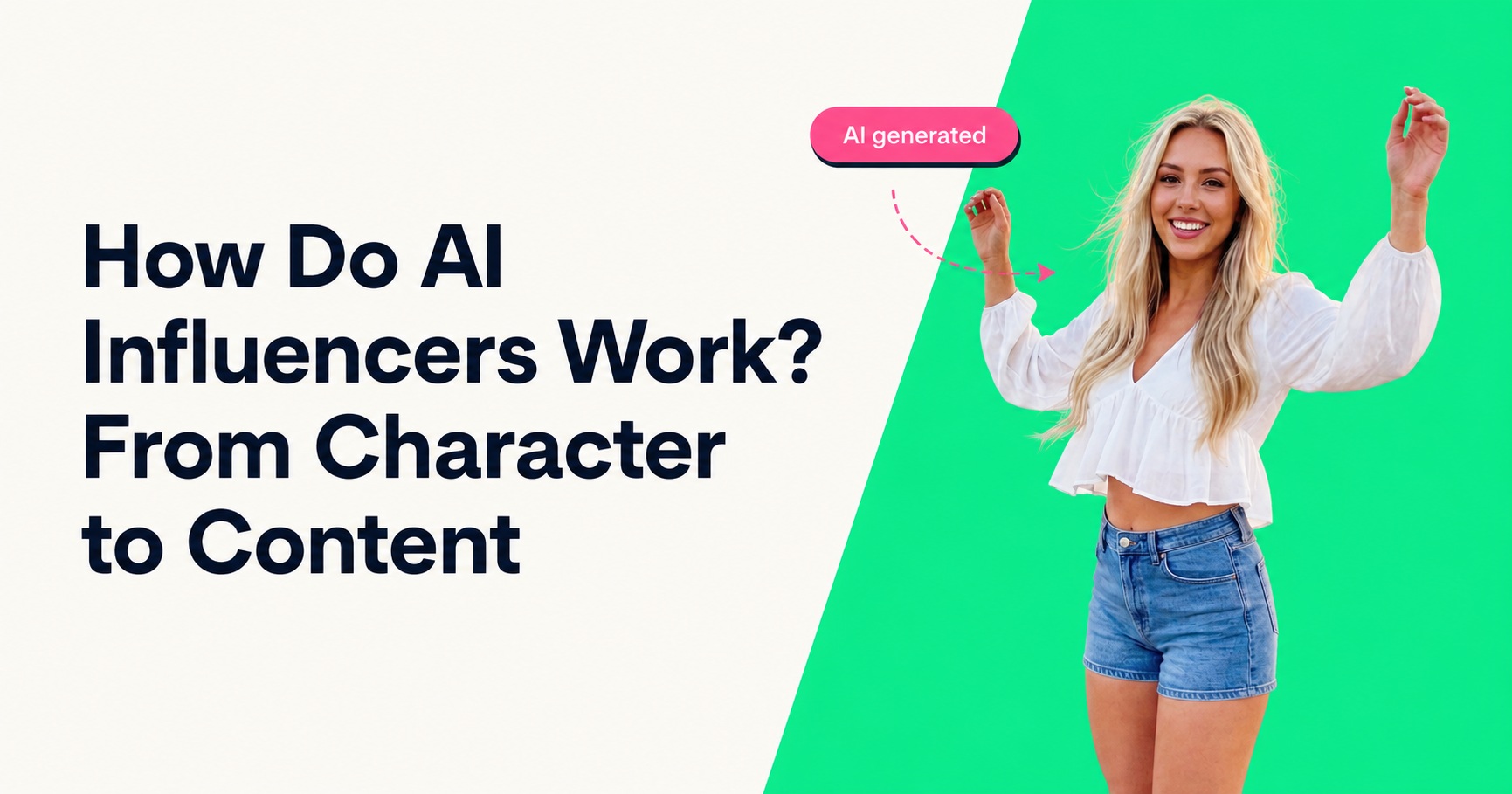
AI influencers can look surprisingly simple from the outside. A virtual person appears in an Instagram photo, publishes a short video, replies in a recognizable tone and returns a few days later in a completely different location. To the audience, it can feel like following any other creator.
Behind the scenes, however, an AI influencer is usually a production system rather than a single AI model. Character design, image generation, consistency tools, video, voice, writing, editing, publishing and analytics all work together. Human creative direction often connects those parts and decides what the audience ultimately sees.
Quick Answer
An AI influencer works through a repeatable content pipeline. A creator first defines the virtual character’s appearance, personality and niche, then uses generative AI to produce consistent images, videos, voice and written content. Those assets are edited, reviewed and published like content from a human creator. The AI handles parts of production, while humans typically control strategy, quality, brand direction and monetization.
Step 1: The Character Comes Before the Content
A successful AI influencer normally starts with a character specification, not with an isolated image prompt. The operator decides what the creator looks like, how old the character appears, what visual style it has, what topics it covers and how it communicates. Clothing preferences, locations, personality traits and even recurring expressions can become part of the identity system.
This matters because consistency creates recognition. If the face, hairstyle, body proportions and overall personality change from one post to the next, the audience does not experience a persistent creator. It experiences a series of unrelated AI images.
The strongest virtual creators therefore use something similar to a brand bible. It can include visual reference images, a written character profile, tone-of-voice rules, preferred content categories and boundaries around what the character would or would not do. That foundation makes later generation faster and more predictable.
Step 2: AI Generates a Consistent Visual Identity
Once the character is defined, image generation becomes the main production engine. Modern generative image systems can create the same virtual person in different outfits, environments, poses and lighting conditions. The challenge is not producing one attractive image. It is producing hundreds of believable images that still look like the same person.
Creators usually solve this by working from a consistent set of references and repeating important character attributes across generations. Depending on the workflow, they may use reference-image conditioning, identity models, fine-tuned models, character embeddings or other consistency techniques. The exact tools change quickly, but the goal stays the same: preserve identity while varying the scene.
A practical workflow often begins with a smaller number of carefully approved images. Those become the visual source of truth for future production. New outputs are compared against them before they are published. This prevents subtle drift from gradually turning the character into someone else.
Step 3: Prompts Turn the Character Into a Content Scene
After the identity is stable, generation shifts from creating a person to creating situations. Instead of asking AI to invent a new character each time, the creator defines what the existing character is doing.
A content prompt might describe location, clothing, camera angle, lighting, expression, activity and visual mood. A travel creator could appear in a hotel lobby, at an airport or walking through a city. A fashion creator might show several looks from the same collection. A fitness creator could move between gym content, meals and recovery routines.
This is where content strategy begins to shape production. The same character can technically appear almost anywhere, but unlimited possibility is not always an advantage. Strong accounts repeat recognizable themes. The audience should understand what kind of creator they are following even when individual scenes change.
Step 4: Images Become Video, Voice and Talking Content
Static images are only one part of an AI influencer workflow. Video makes the character feel more alive and gives creators access to short-form formats that dominate many social platforms.
One approach is image-to-video generation, where an approved character image becomes the starting frame for motion. The system can add head movement, walking, camera motion, gestures or environmental animation. Another approach generates the entire scene as video while using character references to keep the identity stable.
Voice adds another layer. A synthetic voice can give the creator a consistent sound across videos, while lip-sync or talking-avatar systems can match facial movement to spoken audio. This makes it possible to create commentary, tutorials, reactions, greetings or story-driven content without filming a human performer.
The important limitation is quality control. A convincing still image can quickly lose realism when hands, facial movement, physics or lip-sync behave strangely. Creators often generate several versions, select the strongest one and edit the result rather than publishing the first output automatically.
Step 5: Language Models Help Build the Creator’s Voice
Visual consistency is only half of a recognizable character. The AI influencer also needs a consistent way of speaking.
Language models can help generate captions, video scripts, content ideas, replies and recurring formats. The best results usually come from giving the model a defined personality rather than asking it to write generic social copy. Tone, vocabulary, humor, interests and boundaries can all be documented in the same way as visual rules.
For example, a virtual fashion creator might speak in short, confident observations about outfits and trends. A fictional travel creator could use a more personal diary style. A technology-focused AI creator might explain tools and workflows in a practical, educational voice.
Human review remains important because language models can produce repetitive phrasing, factual mistakes or content that does not fit the character. The goal is not to let AI say anything. It is to use AI to express a deliberately designed personality more efficiently.
Step 6: Content Is Planned Like a Real Creator Business
At this stage, the workflow begins to look less like image generation and more like a normal creator operation. Posts need to be planned, scheduled, published and evaluated.
A useful content system mixes several categories instead of publishing the same type of image repeatedly. One post might establish personality, another might tell a short story, another could be a talking video, while another is designed specifically to trigger comments or shares. Paid creator platforms may also require separate premium content designed for subscribers rather than public social feeds.
This is why an AI influencer benefits from a content calendar. The calendar connects production to purpose. Instead of asking, “What should we generate today?” the creator already knows which content pillar, format and objective needs to be produced.
Our guide AI Influencer Content Strategy: How to Grow an Audience That Actually Engages goes deeper into how those content categories work together once the character itself is ready.
Step 7: Publishing Can Be Automated, but Strategy Should Not Be
Parts of the production pipeline can be automated. Content can move from generation into approval queues, scheduling tools and social publishing systems. Captions can be drafted automatically, assets can be stored by campaign or character, and analytics can be collected after publication.
That can make an AI creator operation significantly more scalable than a traditional photo-based workflow. A single operator can potentially manage several characters without organizing physical shoots for every post.
Automation should not mean removing judgment from the process, however. A weak generated image, an off-brand caption or an inappropriate response can damage the character just as easily as poor content from a human creator. The most useful automation removes repetitive production work while keeping creative approval and strategic decisions under human control.
Step 8: Audience Feedback Shapes Future Content
An AI influencer becomes more effective when the workflow is not one-directional. Publishing should create data that feeds back into the next production cycle.
Views can show which formats attract attention. Saves and shares can reveal which posts have lasting value. Comments provide clues about what the audience associates with the character. Subscription conversions and paid content performance can show which themes create commercial value rather than only public engagement.
Over time, the creator can produce more of what works and reduce content that looks good but does not create a response. This is where an AI influencer starts operating like a genuine media brand. The identity remains consistent, but the content system evolves based on audience behavior.
What Part Is Actually Artificial Intelligence?
The answer is often: several different parts, but not everything.
AI may generate the face, clothes, environments, motion, voice, scripts and captions. It can also help organize ideas, automate publishing or analyze performance. But the concept of the character, the business strategy, the creative standards and the final decisions are often still human-controlled.
That distinction matters because the phrase “AI influencer” can create the impression of an autonomous digital person that independently decides what to post. Some experimental systems may move in that direction, but most practical creator businesses use AI as a production layer inside a human-managed workflow.
The creator is synthetic. The operation behind the creator is usually very real.
From Character to Creator Brand
The technical process explains how an AI influencer can produce content, but technology alone does not explain why people follow one.
A character becomes a creator brand when the audience starts recognizing more than the face. The creator has recurring themes, a point of view, a style of communication and expectations around what will appear next. Followers understand the niche and begin forming a relationship with the identity.
That is also the point where monetization becomes more realistic. Brands, affiliate offers, subscription platforms and premium content depend on audience attention and trust. A technically impressive character with no clear identity remains a visual experiment. A consistent character with an engaged audience can become a business.
If you are building that process from the beginning, How to Create an AI Influencer in 2026: Step-by-Step Guide covers the complete journey from character concept through content, audience growth and monetization.
Key Takeaways
- An AI influencer is usually a complete production workflow, not the output of one AI tool.
- Character design establishes the appearance, personality, niche and rules that keep the creator recognizable.
- Consistency systems help preserve the same identity across different images, scenes and formats.
- Images can be extended into video, synthetic voice and talking-avatar content.
- Language models can help maintain captions, scripts and a consistent tone of voice.
- Content calendars and publishing systems turn isolated AI generations into a repeatable creator operation.
- Automation can reduce repetitive work, but human review remains important for quality and brand control.
- Audience data should feed back into production so the content strategy improves over time.
- The technology creates the virtual personality, but audience relationships turn that personality into an influencer.
FAQ
Are AI influencers completely automated?
Usually not. AI can automate or accelerate image creation, video, voice, writing and publishing, but humans commonly control the character concept, creative direction, quality checks, strategy and business decisions. A fully autonomous AI influencer is possible as an experiment, but it is not required to operate a successful virtual creator.
How does an AI influencer stay consistent across different images?
Creators typically use approved character references and identity-preservation techniques so the face and key visual traits remain stable. Depending on the toolchain, this can involve reference conditioning, custom models, embeddings or other character consistency systems. Human review is still useful because identity can drift between generations.
Can an AI influencer make videos?
Yes. AI influencers can appear in image-to-video clips, fully generated video scenes, lip-synced talking content and synthetic-voice videos. Video workflows generally require more quality control than still images because motion can reveal visual inconsistencies more easily.
Who writes an AI influencer’s posts?
The operator can write them manually, use a language model or combine both approaches. Many creator workflows use AI to generate first drafts while a human reviews the final caption or script for accuracy, personality and brand consistency.
Does an AI influencer need a human behind it?
In practical creator businesses, usually yes. The visible character may be synthetic, but humans often manage strategy, production, approvals, platform compliance, partnerships and monetization. AI primarily changes how the content is produced, not the need for creative and business direction.
Final Thoughts
AI influencers work because several technologies are combined into one consistent creator system. Image generation creates the visual identity, video and voice add movement and personality, language models support communication, and publishing tools turn individual assets into an ongoing content operation.
The biggest mistake is treating each generation as an isolated piece of content. The strongest virtual creators operate in the opposite way. Every image, caption and video belongs to the same character, the same niche and the same long-term brand.
That is the real shift from AI-generated content to an AI influencer: not simply creating a virtual person, but building a repeatable system that makes the audience believe that person has a recognizable presence worth following.